Table of Content
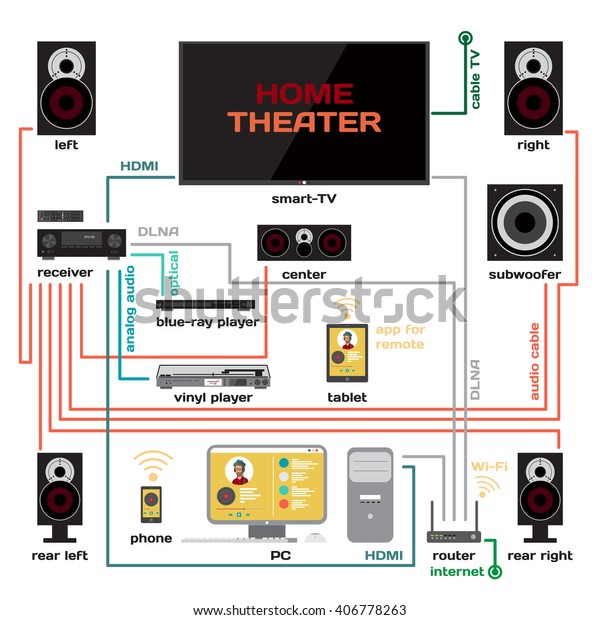
First, we need to look atthe types of connections you will encounter. The following speaker setup examples are typical for a square or slightly rectangular room. You may need to adjust the placement for other room shapes and additional acoustical factors. Connect the incoming cable to the box if you receive programming via a cable or satellite box.

Bring the joy and magic of the movies right to your living room with a home theater. Our guide will help you create the right setup for your space, with tips on choosing the type of TV, speakers, and audio electronics that best meet your needs. We'll also cover where to place your speakers for the optimal sound.
FAQs, speaker placement, room considerations, and other tips.
Below is a general outline of how to connect these different components. Kayla Dube has 4+ years' experience in videography and filmmaking. She frequently works in production with indie film companies. This guide has hopefully made the process a little less difficult for you. If you’re mounting your TV, find the studs in your wall.

Copper has good conductivity and low resistance, but its drawback is that it oxidizes. This is when the pure copper reacts to air and turns green. This will generally happen at connection points, and will massively increase resistance if left alone. All cables have some level of resistance, which refers to the amount of energy lost as the signal passes along it. Obviously, you want as little resistance as possible, but you’re always going to get some.
Connecting the TV to the Sound System
Front left is commonly referred to as FL when using acronyms like that. Make certain you have all of the cables you’ll need for the system’s installation. Check to see if all the cords are included in the package, as they are normally all that you’ll need. An audio input source and a power source are all you need to set up the receiver.
Speakers are placed and hooked up, all your equipment is plugged in, and a few important settings changed. Now, put in our favorite CD, DVD, or Blu-ray and start listening. This is where most people quit; however, the true audioholic is never done with their system.
TV UNIVERSAL REMOTE CONTROL
Most speaker wire is covered in a wax sheath to protect it. You must use scissors or wire cutters to trim this sheath and pull it off, exposing the bright copper wire inside. This wire makes the connection, not the sheath, so you must remove the wax to get your speakers working. Each of your speakers' wires should be able to reach the TV without changing the location or angle of the speakers themselves.If this doesn't work, you may need to buy longer cables for your speakers. If you plan on mounting your TV, hold off on doing so until you've purchased and set up the speakers and other components. It's easy to get carried away while buying equipment only to realize that your TV and/or speakers are too big for your living room!
Generally, all projectors can handle any type; however, specific models are better at taking one kind than another. To explain their positioning in simple terms, mimic the placement of the right and left surround speakers and simply place the rear speakers at a similar angle but behind you. The height at which these are placed does not matter much as the sounds will fill the entire room regardless. Most AV receivers—if not all—have all their rear sockets labeled according to the connections that would go in them. You would simply need to match the labels and connect accordingly.
The audio settings may have a significant impact on the overall sound quality. Connectors that are compatible with your source must be used to connect it to your computer. HDMI, DisplayPort, or a 3.5mm audio jack are all options for connecting to a television. The 3.5mm jack, HDMI, or optical audio input on a computer can all be used to connect to an external sound system or monitor.

The ideal location for your studio should be at the top of your priority list. If you’re like most creative people, you’ll probably start by putting together your studio in your bedroom. It is practical and convenient when making music or an audio-video presentation because you may feel at ease and familiar with the location. When setting up your desk, be sure to leave some space between your speakers and the walls. Although bass straps are convenient, you can also use a sofa or some shelves behind your work as a substitute. If you want a really clean look, or think you will be moving your speakers or equipment anytime soon, installing banana plugs or spade plugs on the ends of your speaker wire is extremely helpful.
In short, this is the relationship between the current and the voltage in a given circuit. While it’s not an issue on its own, mismatches between impedance can cause a signal to reflect back at any point along the circuit, causing loss of quality and potential damage to your equipment. VGA/RGB. This is the most common connection for computers and laptops and is the same type of connection that links computer monitors to the rest of the hardware.

For a DVD player, connect one of the player's video outputs to the DVD video input on the AV receiver. If your DVD player has an HDMI output, use that option. If your DVD player doesn't have an HDMI output, use another available video output combined with a digital optical/coaxial cable from the player to the AV receiver.
If your home theater receiver only offers HDMI pass-through, you may need to make additional analog or digital audio connections between the player and the receiver. There are other connection options to consider if you have a 3D Blu-ray Disc player or 3D TV. This guide provides some basic guidelines for setting up a home theater system. The extent, combinations, and connection options vary depending on how many and what types of components you have, as well as the room size, shape, lighting, and acoustic properties.
The speaker cable’s spade lugs are U-shaped metal clamps. You are probably keen to start your creative skills in the audio-video industry and beyond. Finally, audio-visual consulting is a specialized field that only accepts the best. As audio-visual communication grows in business and education, customers must access high-quality services. Get in touch with us today to chat with a home theater expert and our audio-visual consultant. Discuss your desired outcome, your preferred equipment, and how you want your family to experience it.


No comments:
Post a Comment